Voice Is A Diagnostic


Voice biomarkers
The COVID-19 pandemic didn’t just push us into Zoom calls—it revolutionized healthcare. One of the most fascinating innovations to emerge from this digital shift?
Voice biomarkers: health clues hidden in how we speak.
Think of it this way: your voice isn’t just for karaoke and conference calls. It’s a powerful, non-invasive, real-time mirror of your body and mind. Whether it’s stress, heart disease, or even COVID-19, your voice might be giving away more than you think—and machine learning is finally learning how to listen.
Voice biomarkers are acoustic and linguistic features extracted from speech or vocal sounds that correlate with health conditions. These could include:
Pitch, tone, and frequency (acoustic)
Speech rate, pauses, and vocabulary (linguistic)
They’re not replacing your doctor but acting like a virtual assistant, offering insights into what might be happening under the hood—remotely and effortlessly.
Why Voice? Why Now?
During the pandemic, telemedicine skyrocketed, and the need for accessible, contactless diagnostics became urgent. Voice analysis ticks all the boxes:
Non-invasive and cost-effective
Easily repeatable for tracking disease progression
Works with just a microphone and a quiet room
Plus, it’s engaging for patients, simple to administer, and can be done anywhere—yes, even on your smartphone during lunch.
Why Voice? Why Now?
The Science Behind the Sound
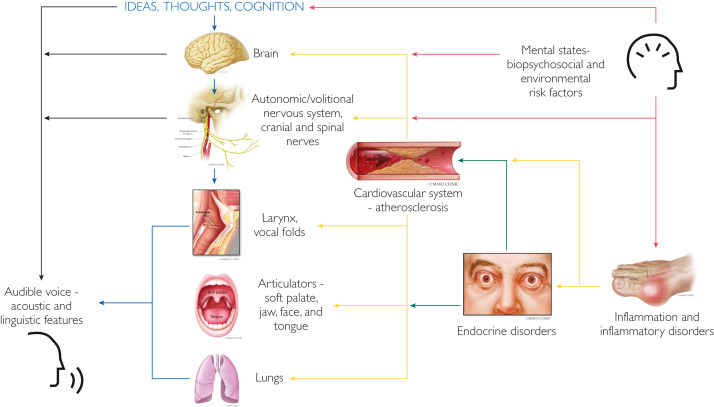
Voice production is a complex orchestra of systems:
Lungs provide airflow
Larynx (vocal cords) generate sound
Articulators (tongue, lips, palate) shape speech
Brain networks and nerves control everything
Any disruption—from inflammation to stroke to Parkinson’s—can affect your speech in unique ways. This is where AI steps in to decode the medical Morse code in your voice.
Mind, Body & Voice
What affects voice biomarkers?
Neurologic diseases like Parkinson’s and Alzheimer’s change how we move and speak.
Psychiatric conditions like depression alter our word choice, intonation, and cadence.
Cardiovascular disease (CVD) impacts laryngeal blood flow, vocal fold closure, and even the brain’s speech control centers.
Endocrine and immune diseases (e.g., hypothyroidism, lupus) can cause vocal cord edema and phonation shifts.
Mental stress (which increases cortisol and inflammation) can sneak into your speech, affecting both your tone and tempo.
In short: if your body’s out of balance, your voice may tattle on you.
How Are Voice Biomarkers Built?
Creating a reliable voice biomarker isn’t as simple as hitting “record.” The process includes:
Recording samples: Can be scripted reading, emotional storytelling, or even spontaneous speech
Preprocessing the audio: Filtering out noise and enhancing clarity
Extracting features: Analyzing pitch, pauses, syntax, sentiment, etc.
Training AI models to detect disease-linked patterns
Testing & deploying for clinical use
The tools used include everything from Mel Frequency Cepstral Coefficients (MFCCs) (yes, they’re a thing!) to advanced deep learning algorithms.
4-dimensional system
A New Classification System
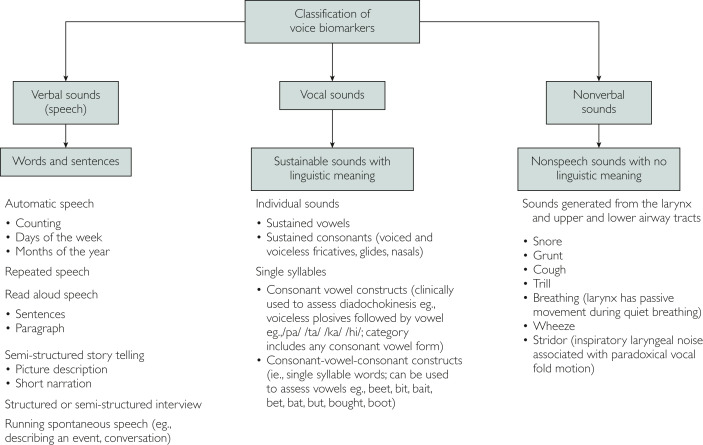
The authors introduce a 4-dimensional system to organize voice biomarkers based on:
Type of sound: Speech, vocal (like humming), or nonverbal (sighs, coughs)
Recording method: Active tasks (e.g., reading), or passive (e.g., spontaneous speech)
Analysis method: Acoustic, linguistic, or both
Recording location: In-person or remote
This helps researchers standardize and compare findings, crucial for scaling up.
The Evidence: Disease Detection Through Voice
Machine learning models have identified links between voice features and diseases including:
Cardiovascular:
Coronary artery disease
Heart failure
Pulmonary hypertension
Neurologic:
Alzheimer’s disease
Parkinson’s disease
Mild cognitive impairment
Psychiatric:
Depression
PTSD
Infectious:
COVID-19 pneumonia (yes, even coughs and breath sounds carry data!)
In one standout study, two voice features—extreme values of MFCCs and intensity skewness—were strongly associated with heart disease, especially when participants described negative emotional experiences.
A revolution to follow!
100,000 people having better health by next year!
Challenges and Next Steps
Before your voice becomes a regular lab test, some major hurdles remain:
Large, diverse clinical trials are needed to confirm accuracy across populations.
Privacy and data protection must be airtight.
Integration into clinical workflows should be seamless and ethical.
The good news? We’re well on our way.
Voice biomarkers are no longer science fiction—they’re a new frontier in digital health. Whether you’re a clinician, tech developer, or curious patient, this is a revolution you’ll want to follow.
🎯 Read the full article for deep dives into methodology, case studies, and the future of voice-based diagnostics. It’s a compelling blend of science, innovation, and practical health care transformation.