Voice a Window into the Brain


Voice as a Window into the Brain: Can Speech Detect Neurological Disorders?
Imagine if your voice could reveal not just how you’re feeling—but whether you’re developing a neurological disorder like Parkinson’s or Alzheimer’s. That’s the big promise behind a fast-evolving area of research aiming to quantify neurological and psychiatric conditions through speech. It’s non-invasive, accessible, and potentially scalable to millions using everyday tech like smartphones.
This systematic review dives deep into how researchers are collecting and analyzing voice data to detect neurological conditions, summarizing insights from 43 studies focused on original voice datasets.
Why Voice?
Neurological and psychiatric disorders—from depression to Parkinson’s disease (PD)—can subtly alter how we speak. Changes in pitch, rhythm, fluency, and even how fast or slow we talk can indicate deeper cognitive or emotional disruptions.
“Speech… is shown to be very susceptible to slight perturbations caused by [neurological] disorders.”
Since most people already use phones and voice-activated tech, collecting voice data unobtrusively could transform long-term disease monitoring—no hospital visit needed.
How the Research is Done
1. Recording Voice Data
Participants are typically divided into two groups: those with the disorder and healthy controls. Researchers use specific speech tasks to extract meaningful vocal signals. These include:
Sustained phonation (e.g., holding an “ahhh” sound)
Diadochokinesis (“pa-ta-ka” repetitions)
Read speech (e.g., reading “The North Wind and the Sun”)
Free speech (e.g., picture description or clinical interviews)
These tasks help isolate patterns that differ between individuals with and without a condition.
2. Feature Extraction
Raw audio is filtered and cleaned through techniques like voice activity detection and speaker diarization (separating voices in multi-speaker recordings). Then, speech is transcribed using automatic speech recognition (ASR) tools.
From here, researchers extract acoustic features—statistical signatures of speech. Some popular toolkits include:
GEMAPS (expert-designed)
COMPARE (data-driven, large-scale)
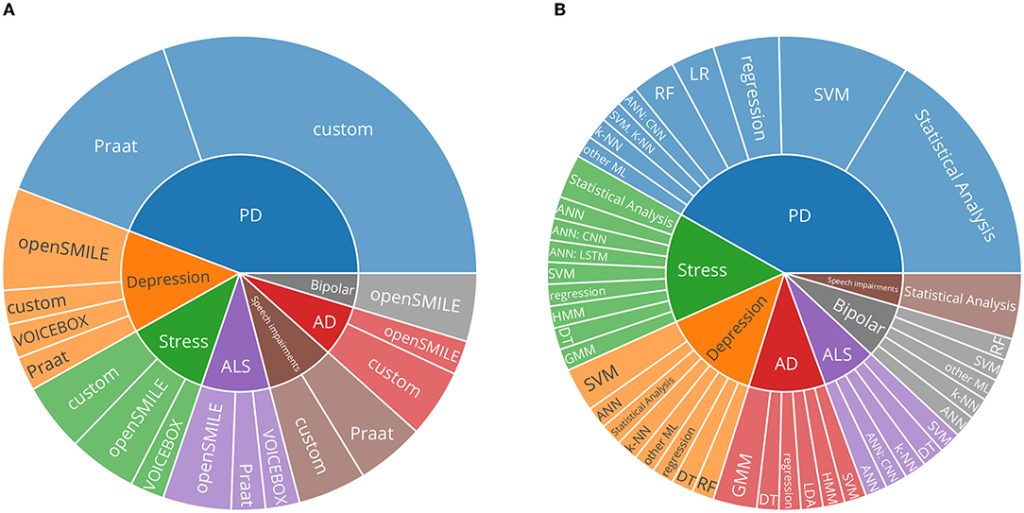
PRAAT, OPENSMILE, DEEPSPECTRUM, AUDEEP (toolkits for advanced feature extraction, including deep learning)
Recent innovations include deep neural network representations and Bag-of-Audio-Words (BOAWS), which summarize speech in a structured, machine-readable way.
How Voice Data is Analyzed
Two main approaches are used:
Statistical Analysis
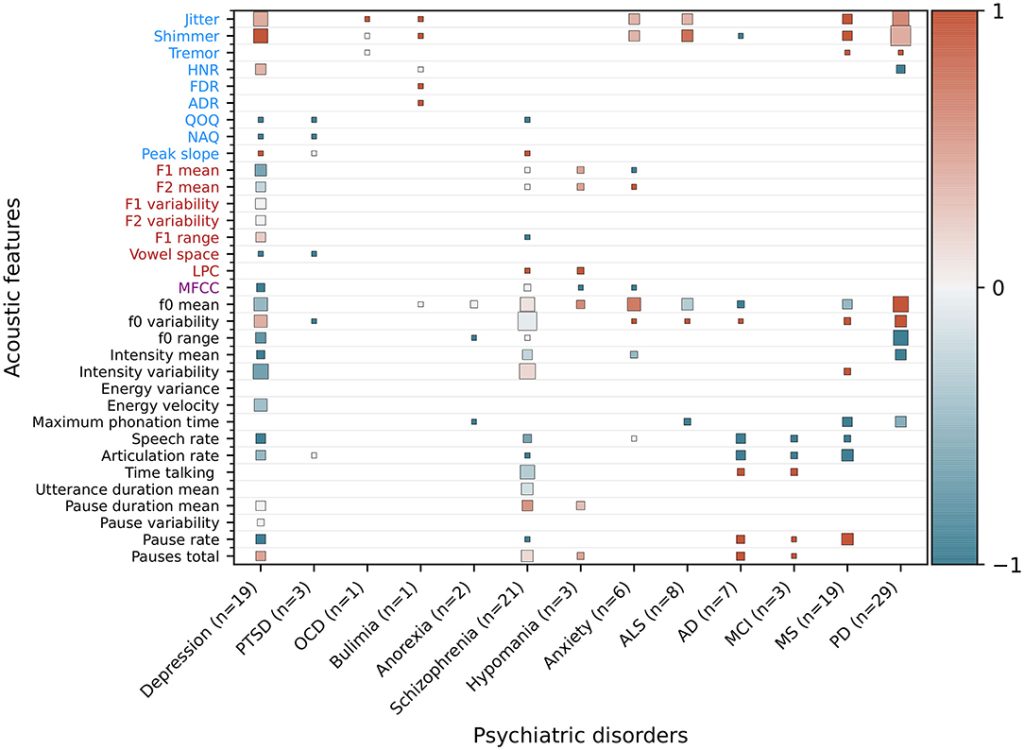
Simple but powerful, this method looks at how features correlate with conditions. For example, slower speech rate or monotone pitch may correlate with depression or early Alzheimer’s.
These patterns are sometimes called “vocal biomarkers.”
Predictive Modeling
Machine learning is where it gets really exciting. Researchers train algorithms to detect patterns and make predictions. Popular models include:
Support Vector Machines (SVMs)
Decision Trees (DTs)
Random Forests
Neural Networks, especially Convolutional Neural Networks (CNNs) and Long Short-Term Memory (LSTM) models
CNNs, for example, can read spectrograms of speech (visual representations of sound) and classify whether a person might have Parkinson’s with surprising accuracy.
Studies increasingly use deep learning to improve accuracy—especially when large datasets are available.
What Disorders Are Being Studied?
Among the 43 datasets analyzed:
Parkinson’s Disease is the most represented (19 datasets)
Depression, stress, bipolar disorder and other psychiatric conditions are also widely studied
Neurodegenerative diseases like Alzheimer’s and ALS, and speech impairments like aphasia and dysarthria are also key targets
Each disorder affects speech in unique ways—whether it’s vocal tremor in Parkinson’s, slowed speech in Alzheimer’s, or flat prosody in depression.
Current Gaps & Future Trends
Despite progress, challenges remain:
Many studies use small sample sizes
Speech is often recorded in controlled settings, not real-life environments
But researchers are shifting toward:
Everyday life data collection (e.g., via smartphone apps)
Multimodal recordings (voice + facial expressions, movement, etc.)
Longitudinal studies to track disease progression over time
“A major recommendation for future studies is to collect data in everyday life… to capture the behavior of participants more naturally.”
Why This Matters!
100,000 people having better health by next year!
This isn’t just academic. If speech-based tools become accurate and scalable, they could revolutionize mental health and neurological care—enabling earlier diagnosis, continuous monitoring, and personalized treatment.
Imagine catching Parkinson’s years earlier—just by analyzing your speech while talking on the phone.
Action
Want the full deep dive? The original report is a goldmine for researchers, clinicians, and data scientists aiming to build next-gen diagnostic tools. It offers:
- Detailed breakdowns of 43 datasets
- Comparisons of analytic pipelines
- Practical guidelines for designing your own studies
👉 Read the full review to understand where this field is heading and how you can be part of it.