Reduce Anxiety
In 15 minutes using only your ears!
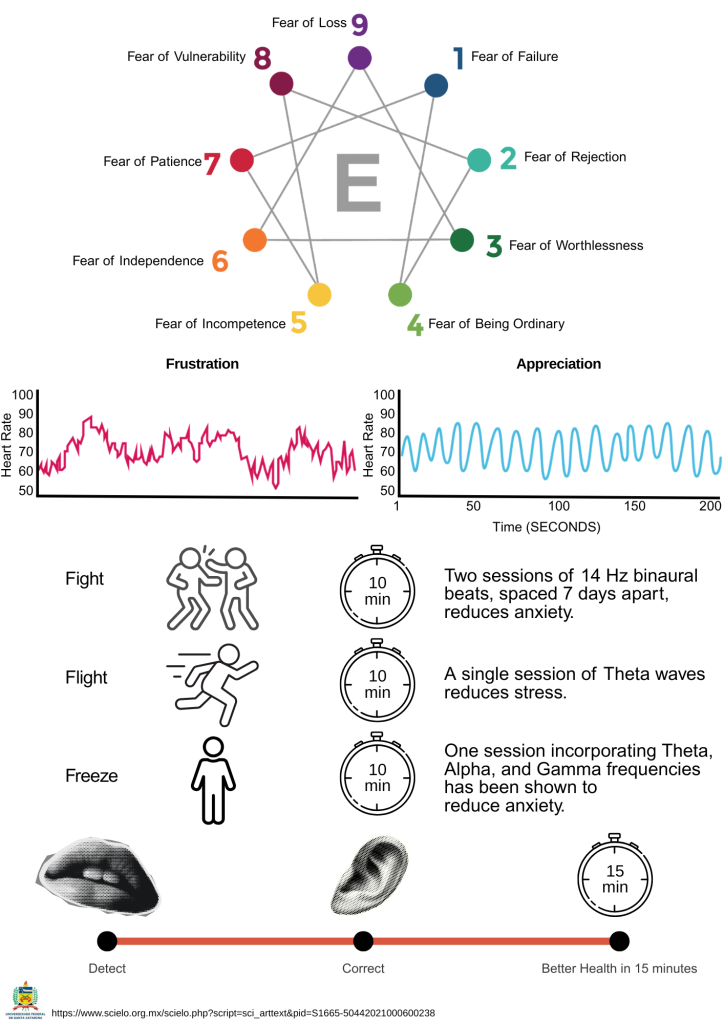
Fear & The Alignment Protocol
The Enneagram describes nine personality styles.
Each relates to fear differently, which is why people under stress can look wildly different. (Enneagram Institute).
Type 1 – The Reformer
Fear of being wrong → tight control and self-criticism.
Type 2 – The Helper
Fear of rejection → over-giving to secure connection.
Type 3 – The Reformer
Fear of worthlessness → constant doing/proving.
Type 4 – The Individualist
Fear of being ordinary → withdrawal/intensifying emotion.
Type 5 – The Investigator
Fear of incompetence → retreat into thinking, conserving energy.
Type 6 – The Loyalist
Fear of losing stability→ scanning for threats; either fight or freeze.
Type 7 – The Enthusiast
Fear of loss → rapid reframing/escape to stimulation.
Type 8 – The Challenger
Fear of vulnerability → pushes against control.
Type 9 – The Peacemaker
Fear of fragmentation → numbing/merging.
What Fear Does to HRV?
All types experience fear under stress”
Heart-rate variability (HRV) is the millisecond change between beats. A healthy heart is not a metronome; variability reflects flexible autonomic control (Shaffer & Ginsberg, 2017).
During fear/frustration, sympathetic drive surges and parasympathetic (vagal) tone withdraws.
On the red graph, that shows up as chaotic, jagged oscillations with low coherence — spikes and drops that don’t follow a smooth pattern.
Reduced HRV is broadly associated with poorer regulation and higher stress load (Shaffer et al., 2014; Ernst, 2017).
“Positive emotions and self-regulation increase coherence in bodily processes, visible as a smooth HRV pattern.” — McCraty & Shaffer, 2014
Why 15 Minutes of Alignment Protocol Helps (and the Studies Behind It)
Beta-range (14–16 Hz) binaural beats → less anxiety in minutes
Short exposures in the beta range (14–16 Hz) have reduced stress responses and improved task performance in lab settings.
An fNIRS study using 16 Hz binaural beats showed reduced stress and better cognitive performance in 10-minute sessions (Al-Shargie et al., 2022).
Other peri-procedural trials using 10 Hz also significantly lowered anxiety (Opartpunyasarn et al., 2022).
A 2024–2025 evidence review concludes binaural beats can acutely reduce anxiety, with theta/alpha/beta all showing benefit in different contexts (Baseanu et al., 2024; Yang et al., 2025).
A single theta session → lower stress, better HRV
Theta (≈6 Hz) sessions have been linked with relaxation and improved HRV dynamics even after one exposure.
Post-exercise theta listening increased relaxation and modulated LF/HF HRV components in a single session (McConnell et al., 2014).
Reviews and trials report theta binaural beats reduce anxiety and improve sleep when used acutely or over 2–3 weeks (Yang et al., 2025).

Decreased Anxiety
One mixed session (theta + alpha + gamma) → anxiety down
Combining bands can be potent.
A randomized clinical trial found music + auditory beat stimulation reduced cognitive & somatic state anxiety more than controls in one sitting (Mallik & Russo, 2022). College-student data show theta, alpha, and beta 20-minute sessions all decreased anxiety and improved autonomic measures, with no single band strictly superior (Yang et al., 2025).
Emerging reports using 6 Hz, 10 Hz, and 40 Hz in one protocol have likewise shown acute anxiety reduction and improved physiology (Rankhambe, 2022).
Emotional calm
Appreciation & Emotional Calm — Reading the Blue Line
When you shift into appreciation (or gratitude), breathing naturally settles near ~6 breaths/min (~0.1 Hz).
Vagal tone rises and HRV becomes a large-amplitude, sine-wave-like pattern — a hallmark of cardiac coherence.
That’s what you see in the blue graph: smooth, rhythmic oscillations with high variability (good!) indicating synchronized sympathetic–parasympathetic rhythms (HeartMath science overview; McCraty & Shaffer, 2014; Petrova et al., 2021).
“Positive emotion states are linked with higher HRV coherence and improved cognitive function.” — Balaji et al., 2025
The Alignment Protocol Gets You There in 15 Minutes
Detect: A 90-second voice analysis gets to the root cause of stress load.
Correct: You listen with comfortable headphones as we deliver neuroacoustic layers (theta/alpha/gamma plus a gentle beta window ~14–16 Hz when focus/anxiety warrants).
Coherence: Sessions cue slower breathing and vagal rise; HRV becomes smoother and higher-amplitude (blue-line pattern).
Evidence base: HRV fundamentals and clinical meaning (Shaffer & Ginsberg, 2017); acute BB effects on anxiety/ANS (Yang, 2025; Mallik & Russo, 2022; Al-Shargie, 2022; Opartpunyasarn, 2022).
Try It Today
